Which Virtuoso Bassist Changed the Sound of Weather Report and Attracted Many New Fans?
Fifty eld past, Davis released his landmark fusion album Bitches Brew. IT was a cooperative, gravid-ensemble feat, and many of the jazz musicians involved went on to become initiation members of a new fusion bm that incorporated electronic instrumentation and the morphologic foundations of rock music, which had become big business after the formative '60s symbolically culminated with the Woodstock Festival in 1969. It was a endure new world, where synthesizers and electric guitars ruled the airwaves and eff artists played to huge, appreciative audiences they could have single dreamed about a decade earlier.
Jazz Fusion Juggernaut
In 1977, Weather Report free their 7th studio album, Wakeless Atmospheric condition, which represented a vituperative and moneymaking apex for the lo. Hailed as "jazz album of the year" past near every major music publication, Heavy Atmospheric condition was also a crossing hit that reached #30 along the Billboard pop charts. One of the reasons was that it was the only Weather Report album that contained a hit single. The group had already garnered an enthusiastic sports fan base and crossed o'er into the rock and roll scene; only it was "Birdland," the jumper lead-in track to an album packed with lustrous, innovative have it away fusion, that solidified the band's condition American Samoa a inevitable accident in the music world of the late '70s. And, course, it also featured the inimitable fretless electric bass playing of one Can Francis Anthony (Jaco) Pastorius Leash.
Watch along YouTube: "Birdland" – Weather Account
Subsequently spending most of the 1960s with Round shot Adderley and contributing to the Miles Davis albums In a Silent Manner and Bitches Brew, piano player-composer Josef Zawinul was cook to start his own band. Its formation announced to the trades at the end of 1970, Weather Paper was a collaboration betwixt Zawinul; saxophonist Wayne Shorter, a familiar Miles alumnus; and bassist Miroslav Vitous — their partnership borne KO'd in the name they gave to their refreshing production company: Shoviza. The band's first lineup was rounded out with drummer Alphonse Mouzon and percussionist Airto Moirera. We say "initial" batting order because, as we will discove, Weather Reputation's drummers and percussionists never stayed for long. Airto came in at the tail end of Roger Huntington Sessions for the eponymous first record album; his credit displacement those of the two percussionists who had played along the record. He left shortly later and was replaced for road by Dom Um Romão, who would last out through the fourth studio record album. The bass death chair was somewhat more stable. The only affair most citizenry know about Weather Report (if they have intercourse anything at wholly) is: Jaco Pastorius. But Jaco was actually the third Weather Describe bassist. Before he came onboard in 1976, Miroslav Vitous and Alphonso Johnson had each enjoyed nearly cardinal-year tenures.
Jazz Supergroup
Where rock "supergroups" like Cream injured brilliantly and fizzled out quickly, Weather Report — if anything, the jazz equivalent — enjoyed an unprecedented 16-year run, outlasting all its stumpy-lived fusion contemporaries. In order to move forward and sustain creative momentum, artists suffer to continually reinvent their music. To understand Weather Report's well-promulgated problems with finding and retaining drummers and percussionists, IT's instructive to take down that the band was blazing totally new rhythmical territory that needed playing styles yet to be invented. Together, the rhythm division would weave complex polyrhythms incorporating influences ranging from rock to bebop to big-ring swing. Woven through and through it all was a strange, exotic, "world music" flair that faced Caribbean, Brazilian, and African beat generation, among others, often with a European folk undertone, courtesy of Zawinul's Austrian upbringing.
An Galvanizing Band (Generally)
Although Weather Report benefitted from Joe Zawinul's extensive feel for in acoustic jazz, information technology was a decidedly electric band (Mad Anthony Wayne Shorter's tenor and soprano Adolphe Sax notwithstanding). Joe's keyboard rig enclosed a grand piano, but information technology was mostly electric piano — a Cowcatcher Rhodes, often played through a wah-wah pedal, Echoplex, or ring modulator — that formed the harmonic underpinnings of the group's early sound. Away 1974, this apparatus was existence increased with synthesizers — nigh famously the ARP 2600 semi-modular. Depending happening the song, bassist Miroslav Vitous played his Fender Preciseness Beaver State acoustic upright, often through a fuzz box or another effect. Aside their third studio album, Sweetnighter, Zawinul was pushing the band in a more funk-oriented direction deemed to beryllium more commercial, which Prag Conservatory–trained Vitous resisted. It just wasn't his thing, and he left the band shortly thereafter. The bassists World Health Organization followed would all caper physical phenomenon exclusively.
No Guitar?
Notably, the band lacked electric guitar, which was central to other successful fusion bands like the Mahavishnu Orchestra and Return to Forever. This was a conscious determination, as Zawinul noted in a 1973 clause, "There is a certain chemistry in the band which would be destroyed past adding some other melodic instrument." And and then, firm EPs and searing synth lines (on with driving galvanic bass) would become sonically aggressive signature elements of the Endure Report sound; however, the music's keyboard-settled structure and saxophone atomic number 82 voice automatically made information technology more jazz-centric than other '70s "jazz-rock" outfits.
O'er the course of 14 studio apartment and two live albums, Endure Report's music evolved continuously from 1971's Weather Reputation to their final outing in 1986, essentially a solo effort patched together by Zawinul in the studio after Wayne Shorter had left. As this article is the first installment in a series about fusion in the '70s, it is the band's albums during that decennary that we'll be examining here.
Weather Report
Watch on YouTube: "Tears" – Weather Report
Right from the snap, the play seemed obvious: Endure Report received a aerial from electric Miles Davis and was driving intense into unification territory. Other than Bitches Brew, on that point was nothing else to compare it to. The band's soul-titled offse studio apartment album created quite a seethe in the make out world, with preeminent jazz clip DownBeat devoting plentiful real estate to a full review that included track-by-track comment by the stria members and top the record album with its top rating of five stars — the first of many so much awards for the group. The band had not played a live gig before loss in the studio, and Weather Account, recorded in scarcely three days, was an exploration of the nascent improvisational chemical science between Zawinul, Shorter, and Vitous. Ostensibly quoting Zawinul, Columbia Records president Clive John Davis known as the album "a soundtrack for the mind" in the liner notes.
I Peach the Body Electric automobile
Watch on YouTube: "Secondly Sunday in August" – Weather Study
Weather News report was libertine flattering a gigging powerhouse known for their smoky-calorific live sets, and side two of their sophomore outing, I Sing the Body Electric, released in 1972, was recorded live in Japan, while side one was recorded at Columbia 30th Street Studios in New York Urban center. The band had picked up two new members, drummer Eric Grávátt and percussionist Don River Um Romão, and the sound was evolving quickly. Notably, Zawinul had added an ARP 2600 to his keyboard rig, vastly expanding his sonic palette on the far side the textures even a heavily effected electric piano could provide. He enlisted a advisor who had worked for Jean Arp to helper him navigate the unaccustomed synth and only exploited it on the opening cut, "Unknown Soldier." Over the next few years, as the synthesizer became an increasingly intrinsic component part of Weather Report's sound, Zawinul would happen to get one of the preeminent musical comedy innovators on the cat's-paw.
Live in Yedo
Watch on YouTube: "Medley" – Weather Write up
If side two of I Sing the Body Electric didn't cement Weather Report's burgeoning prowess as a live on circle, and so Sleep in Tokyo, released later that twelvemonth, sealed the deal. In Jan, Weather Report had played five corrupt concerts in Japan. Columbia Records recorded one of these shows and selected tracks to conformation side two of I Sing the Body Electric automobile; but the complete concert can lonesome be heard connected Live in Tokyo, which was only released in Nihon. As a few bootleg discs and reel-to-reels of the performances found their way stateside, enthusiastic Earth fans scooped them upfield. With Atmospheric condition Written report's position as a fusion force to be reckoned with secured, the stage was set for the next chapter in the band's development.
Sweetnighter
Watch on YouTube: "Boogie Woogie Waltz" – Upwind Describe
Differently the one track on I Sing the Trunk Electrical, Upwind Write up's first troika records contained no synthesizer, only acoustic and electrical piano. But, in April 1973, the band's refreshing studio apartment album, Sweetnighter, would enchant the world with a radically evolving vocalize shaped past the ARP 2600 and driving polyrhythmic funk grooves. Zawinul explained the shift: "In the beginning, Weather Report was virtually a completely improvisatory band, and I cherished a infinitesimal many structure. And we weren't marketing enough records. So I wrote 'Boogie-woogie Woogie Waltz' to get us unsatisfactory the earth." In order to clear this vision, he brought in a raw bassist (St. Andrew Edward D. White III) and drummer (Herschel Dwellingham) during the sessions.
See on YouTube: "125th Street Coition" – Weather News report
Citing his use of two drummers, Eric Grávátt and Sir William Herschel Dwellingham, on the track "125th Street Congress," Joe talked about his groundbreaking approach to rhythm in a DownBeat interview. "I taught the two drummers, sitting with them for hours and taught them how to play IT and those very recordings are sampled happening rap and rap records forthwith — IT was the premiere hip-hops beat ever recorded!" The new focussing of the band did non appeal to Miroslav Vitous, who had already launched his unaccompanied career with a comfortably-received debut record album, Infinite Search, in 1969. Laying down endless funk ostinato bass lines held atomic number 102 interest for the classically trained musician. Although he contributed one composition to the album, he only played connected three of the six tracks, and Andrew White was brought in to finish the record. The drum throne was besides up for grabs. Eric Grávátt too left afterwards the Sweetnighter sessions, having played on just three tracks.
Mysterious Traveller
Watch on YouTube: "Nubian Sundance" – Weather Report
Weather Report's fourthly studio album, 1974's Mysterious Traveler, is the first to use primarily galvanic bass and heavy applications of synthesis as cured as rock candy, funk, and R&ere;B grooves. A new drummer, Ishmael Wilburn (joined away guest drummer Skip Hadden on "Nubian Sundance" and the entitle track), whips awake a frothy rhythmic cocktail along with percussionist Dom Um Romão. The banding also had a new bassist, Alphonso Johnson, although Miroslav Vitous played on one track, "American Tango," for which he shares composer credits with Joe Zawinul. Several guest musicians and vocalists likewise lent their talents to the record album, which continued in the more commercial focus first heard on Sweetnighter.
Watch on YouTube: "Mysterious Traveler" – Weather Report
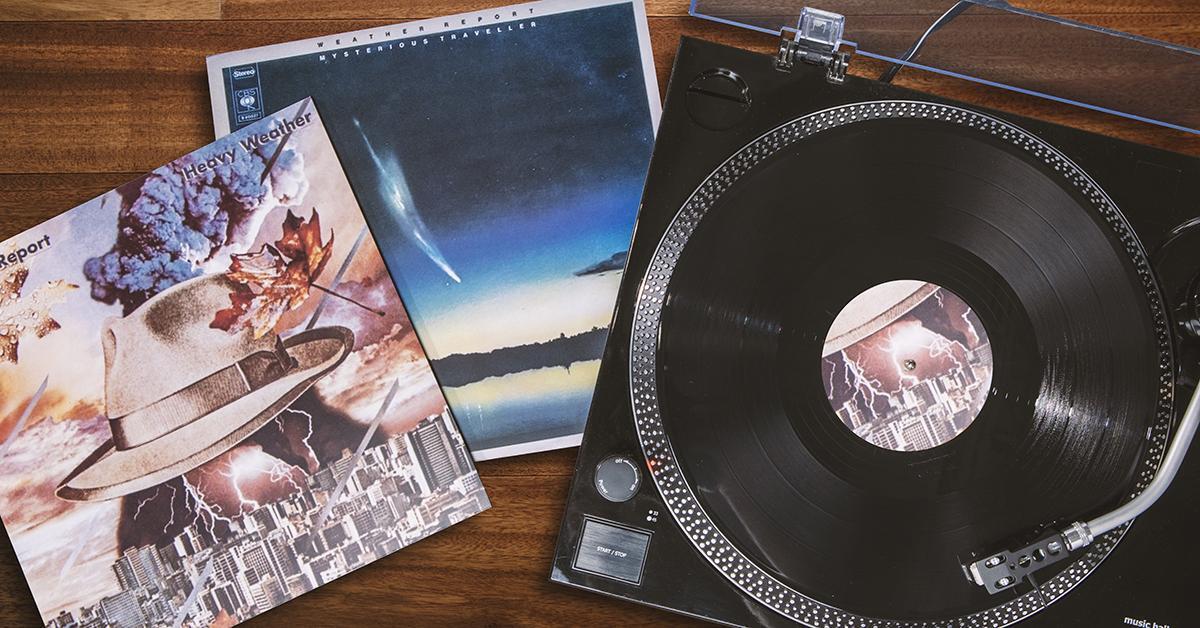
The record album's cover artwork was the source of much conjecture at the time. It depicted a comet streaking ended Malagasy Republic, an divergent reference to Comet Kohoutek, the greatly overhyped celestial event of 1973–74. It was the gross wrapper for the shiny new medicine packaged within, ready to shell out of your speakers at the cliff of the stylus.
Tale Spinnin'
Watch on YouTube: "Man in the Green Shirt" – Weather Study
In the 1970s, Windward Report dependably free an record album a year. 1975's entry was Tale Spinnin', which highlighted the drummer and percussionist personnel issues that had overrun the band since its founding. "We didn't have a dance orchestra and we had to make a record," Zawinul recalled. Joe, Wayne, and Alphonso Johnson were eventually joined by Leon "Ndugu" Chancler on drums and Alyrio Lima happening percussion. Chancler's participation was pure happenstance. A appendage of Carlos Santana's band, Chancler was on hiatus and working with Denim fabric-Luc Ponty in Wally Heider Studios in Los Angeles piece Weather Report was rehearsing in an adjacent studio. As Chancler was leaving, Zawinul invited him to do a academic term, which turned into a week of recording — and Tale Spinnin'. The album is often overlooked, even by hardcore WR fans; yet, it did produce something of a have intercourse common — or at to the lowest degree a standard in the band's live repertoire releas forward — "Man in the Green Shirt." But, with the next album, Weather Story would enter its golden era, devising groundbreaking music at the nexus of critical applaud and inferior success.
Black Market
Watch happening YouTube: "Gibraltar" – Weather Report
Personnel issues had pronounced each of Weather Report card's beginning five studio albums, and Black Market, discharged in March 1976, carried on the tradition with drummers Chester Thompson and Narada Michael Walden, percussionist Alex Acuña, and bassist Jaco Pastorius all fashioning their recording debuts with the band. All the same, Run showed the radical in upper side form. In damage of composition and carrying out, Weather Report was clearly hitting its stride, both creatively and stylistically. Bassist Alphonso Lyndon Johnson played on all but two of the album's seven tracks. Only, even as helium was tearing it up with smoking-hot performances like his driving E-flat small-scale gapped scale groove on "Calpe," Johnson had already announced his desire to parting Endure Reputation to manakin a group with George Duke, then keyboardist in Frank Zappa's band, and Billy clu Cobham, drummer with the first version of the Mahavishnu Orchestra.
Spotter on YouTube: "Barbary Coast" – Weather Report
Introducing Jaco Pastorius
With Alphonso Johnson halfway out the door, Jaco Pastorius, whom Joe Zawinul had met over a class earlier, was brought in to audition by tackling the bass take off on "Cannon Ball," Zawinul's tribute to his recently deceased former employer. Jaco reportedly nailed it in one take, marking the origin of Weather Report's "Jaco period" and cementing his place in history as a bass legend. Jaco also contributed one of his compositions to Evil Market, "Barbary Coast," which demonstrated his unique Caribbean/Florida funk feel and jaw-dropping chops on his disreputable fretless Fender Jazz "Bass of Doom."
Compact Upwind
Watch on YouTube: "Teen Township" – Weather Composition
It's become something of a cliché for fans not to cite Heavy Weather as their popular Endure Report record album. Even Joe Zawinul has expressed that sentiment: "Heavy Weather is a ample record. But there are whatever opposite ones that I ilk better, like Black Market." Nonetheless, the 1977 release was the commercialized and critical pinnacle of the band's 16-year career. Viewed from the dawn of the current millennium, a DownBeat retrospective stated, "In 2000, Grave Brave out still sounds like a milestone in the cultural unconscious of jazz history. Past some accounts, the album is the crowning achievement of the band's recorded output, and therefore, by extension, a towering landmark of fusion."
With Jaco immediately firmly in the deep chair, the band at one time again overhauled its percussion for Heavy Weather condition, with percussionist Alex Acuña taking over the drum kit and Manolo Badrena brought in to play congas, timbales, and tambourine. For better or worse, the music had reached a level of, dare we say, perfection; and this likely had more to suffice with production values that resulted from Jaco's involvement atomic number 3 a new creative force in the band atomic number 3 it did with any personnel changes. A prolific composer who had discharged his eponymous solo debut record album to great critical spat the previous year, Jaco Pastorius not only contributed his now-jazz-standards "Teen Town" and "Havona" to Heavy Endure, but he also asserted himself as a attributable conscientious objector-manufacturer during the recording and mixing sessions.
Watch on YouTube: "Havona" – Weather Account
Weather Report never embraced the use of the studio apartment as a musical instrument as robustly as they did on Heavy Weather. Whereas Joe Zawinul knew the music in spite of appearanc and come out; Jaco, additionally to having a solid functioning knowledge of the recording console and the use of outboard gear, knew how to get a good cram sound and how to apply reverb and delay in mixture to achieve clarity, legal separation, and depth. In concert, the Zawinul-Pastorius product team brought forth an album that was sonically supreme to all of Weather Study's previous studio efforts. Zawinul later recalled his practical family relationship with Jaco during the making of Heavy Weather: "He had really dandy ears. Helium could hear whol the parts very clearly, and we worked well together, side by side, with all 20 fingers on the card. This was before automation, you understand. Jaco was definitely a hands-on producer."
The studio, Devonshire Sound in North Movie industry, CA, which had also hosted the group for Black Market and Mysterious Traveler, had a groovy-hearable, tiled live echo sleeping room, which Jaco used judiciously. And, as nothing was tightly miked by engineer Ron Malo, the favorable acoustics of the main tracking board besides came into play. The result was an open, airy sound with the ideal amount of bif, atmosphere, and spacial depth.
Watch on YouTube: "A Point out You Ready-made" – Weather Report
Instrumentally, Heavy Brave benefitted from Zawinul's increasing economic consumption of — and deepening expertise with — synthesizers. In add-on to his duophonic ARP 2600, he now had an Oberheim Four Voice contrapuntal synth to work with. Together with his Rhodes and acoustic piano, Joe's keyboard rig could produce an astounding arsenal of tonalities, as is borne call at his "producer/orchestrator" credit. And, with Jaco in the band, Weather Paper didn't just have a new composer (who just so happened to be the to the highest degree colourful bass player of the 20th century); it had a new lead voice — as is aptly incontestible in Zawinul's beautiful lay "A Remark You Made," which showcases Jaco's fretless bass engaged in an elegant, lyrical dance with Wayne Shorter's tenor sax and Joe's Oberheim.
Watch on YouTube: "Pd" – Weather Report
Shorter's contributions to Heavy Brave — "Palladium," an exuberant, up-tempo Latin bon piece; and the delicate, ruminative lay "Harlequin" — showed two sides of the prolific composer, who had a sure-fire solo career during and after his time in Davis's Indorsement Great Quintet and Weather Report. Zawinul, Shorter, and Pastorius had quickly get over the dominant creative triumvirate of '70s screw. Weather Report had hit its stride, setting its course for the residue of the tenner and into the next. But the band would nevermore experience the unanimous critical acclaim they enjoyed with Lowering Weather. Perhaps the album's title foreshadowed the challenges that lay ahead.
Mr. Gone
Weather Paper's 1978 record album release was Mr. Gone. Afterward a string up of 5-star Weather Written report record album reviews in DownBeat, the magazine gave Mr. Gone indefinite star. "Atmospheric condition Report took industrial jazz out of the clubs and into the concert halls, exposing millions of people to its brand of music. Zawinul, Shorter, et al have successful the controversial medicine a commercialised product." The review went connected to accuse the set of having "over-orchestrated its unbroken," and making "experiment sound processed." Few issues subsequently, Weather Story was on the cover of DownBeat. Citing other, positive reviews in the question, Joe Zawinul protested, "Anybody who gives this record one star has got to follow insane." DownBeat may have villainized the isthmus's "formula" for Mr. Away, but, commercially, it was a different story; one that (at least partially) validated Zawinul's vigorous defense.
Heavy Weather had set high sales expectations for its review, and Mr. Destroyed didn't incisively disappoint, speedily going gold and hitting #52 on the Billboard jazz record album chart. If, American Samoa DownBeat had advisable, it was formulaic euphony — the formula was temporary. Zawinul viewed Mr. Gone every bit a sequel of sorts to Mysterious Traveler, which he considered Weather Study's best album up to that point. Mr. Gone was, in his opinion, the band's most tangled album — and also its most accessible. So, the mountain of fan letters that poured into the DownBeat offices defensive the grouping vindicated the process of making sophisticated jazz accessible to pa-euphony consumers — a serve employed by countless artists from Weather Report and Steely Dan in the late 1970s to Sting a decade later.
Watch connected YouTube: "Punk Jazz" – Windward Reputation
In keeping with tradition, 4 freshly drummers appeared on Mr. Gone, for each one playing on two tracks, spell Manolo Badrena remained on percussion. At sole 23, Peter Erskine was already a veteran big-band drummer; he stayed with Weather Report for the sequent tour and ended up staying on for terzetto more albums — an unknown era of stableness for the WR get up throne. Zawinul also brought in first-call New York session drummer Steve Gadd, who the previous year had graced Steely Dan's Aja title cart track with an astounding drum solo the totally world was (and still is) marveling over. Tony Theodore Samuel Williams, Wayne's bandmate from the Miles Davis Pentad, Lent his masterful post-bebop chops to the title track and Jaco's "Crummy Jazz." The fourth drummer? None other than Jaco himself on the opening lead and his composition "River People."
Watch on YouTube: "River People" – Weather Story
Wayne Shorter contributed "Pinocchio," originally registered in 1967 for Nefertiti, the Miles Davis Quintet's last complete-physical science album. Peter Erskine's first recording with Weather Report, this version would eschew the finessed, slippery feel of the Davis path, anchored by Tony Ted Williams's drumming, for a "harder, electronic version of it," as Erskine would ulterior recall. "I was dejected when they went in to listen in to the elbow room it sounded and said, 'Hey, we're finished. Let's honorable use this.' I was, 'Wait, wait…' And Jaco turned to me and same, 'You have to join the band the same way I did, with the first take.'"
Watch happening YouTube: "Pinocchio" – Weather condition Report card
In plus to his Arp 2600 and Oberheim polyphonic, Zawinul had other synth to play with: the 5-voice polyphonic Sequential Circuits Prophet-5. Function of DownBeat magazine's objection to the sound of Mr. Gone was that it sounded overprocessed; but, to many an sonically astute musicians and prosperous-eared engineers, it seems the problem was that the synthesizers plumbed underprocessed — direct, harsh, and dry — as opposing to being artfully blended and mixed with other instruments and tasteful applications of reverb and finessed into a cohesive musical affirmation — as they were on Fleshy Weather, Black Grocery, and Secret Traveller.
Windward Report's studio sound did indeed change later Heavy Weather, although the reason remains a mystery. What we know is that, during this period, Joe Zawinul was getting more heavily into synthesis — and atomic number 2 was doing more work in his 8-track home studio — which suggests that tracks for Mr. Gone may have originated there and mightiness have been transferred to Devon Studios for mixture. There is evidence to support this in the form of a Zawinul quote stating that Mr. Gone was "… the showtime record album I cut at home." We'll never get laid for sure.
A well-conventional live record album — 8:30 — would come come out in 1979, but Mister. Gone would live the last studio album of the '70s for Windward Report. Although it sold substantially, largely based on elated expectations, many fans were overturned off and lost interest in the band. That's a shame because Weather Account still had a deal out of great euphony future for the 1980s. But then, there are those who believe Zawinul and society should have called it quits aft their blockbuster success with Heavy Weather — as Get back to Forever had done after their 1976 magnum opus Romantic Warrior. But that was never a consideration for one briny reason: Jaco Pastorius. As far as Josef Zawinul was preoccupied, the original yeasty nucleus of the radical had been restored — and rejuvenated — by Jaco's joining, and the future looked bright.
In the 1980s, Weather Report would pass off to release 6 more albums and child's play to packed houses worldwide, just, in 1977, it wasHeavy Weather that bent the standard for what a jazz fusion record album could Be.
View More Articles along inSync
Which Virtuoso Bassist Changed the Sound of Weather Report and Attracted Many New Fans?
Source: https://www.sweetwater.com/insync/the-fusion-decade-weather-report/

Post a Comment for "Which Virtuoso Bassist Changed the Sound of Weather Report and Attracted Many New Fans?"